
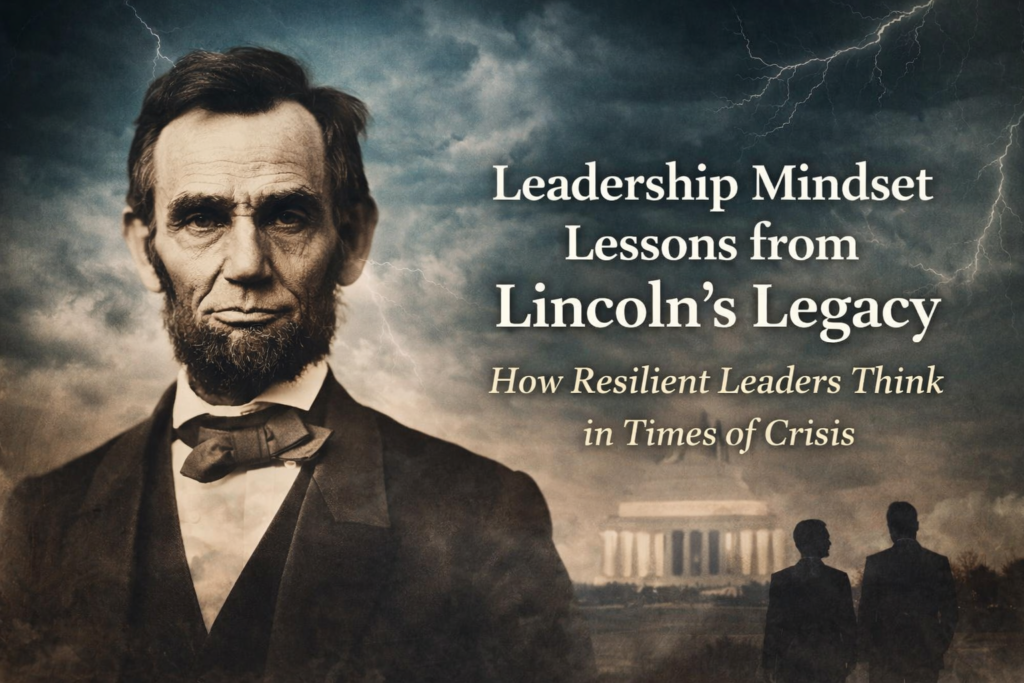
Leadership Mindset Lessons from Lincoln’s Legacy: How Resilient Leaders Think in Times of Crisis 2026
In an era defined by unprecedented change, technological disruption, and global uncertainty, today’s leaders face challenges that test their resilience daily. While our modern context may seem uniquely complex, the fundamental principles of resilient leadership transcend time. Perhaps no historical figure better exemplifies this timeless resilience than Abraham Lincoln, whose leadership during America’s greatest crisis offers a masterclass in maintaining clarity, purpose, and adaptability when facing seemingly insurmountable challenges.
What makes Lincoln’s approach so relevant for leaders in 2027 isn’t just what he accomplished, but how he thought. His resilient leadership mindset characterized by intellectual flexibility, emotional fortitude, and unwavering moral clarity provides a framework that modern leaders can adapt to navigate today’s volatile, uncertain, complex, and ambiguous (VUCA) landscape. This article explores how Lincoln’s leadership principles can be translated into a practical resilience framework for today’s most pressing leadership challenges.
The Lincoln Paradigm: Resilience in America’s Darkest Hour

Lincoln’s resilient leadership was forged in the crucible of the Civil War, America’s greatest existential crisis
When Abraham Lincoln took office in 1861, he inherited a nation literally tearing itself apart. The challenges he faced from military setbacks to cabinet infighting, from public criticism to personal tragedy—would have broken many leaders. Yet Lincoln’s response to these pressures reveals core elements of a resilient leadership mindset that remains instructive today.
Case Study 1: Managing the “Team of Rivals”
Perhaps Lincoln’s most remarkable leadership feat was his deliberate assembly of a cabinet filled with former political opponents men who had competed against him for the presidency and often held views dramatically different from his own. Rather than surrounding himself with loyalists, Lincoln recognized that diverse perspectives were essential for effective crisis management.

Lincoln’s “Team of Rivals” approach demonstrated his confidence in seeking diverse perspectives
This “Team of Rivals” approach revealed several key aspects of Lincoln’s resilient mindset:
- Intellectual humility: Lincoln recognized that he didn’t have all the answers and was willing to surround himself with people who would challenge his thinking.
- Emotional security: Unlike insecure leaders who feel threatened by dissent, Lincoln was confident enough to welcome opposing viewpoints without taking disagreement personally.
- Integrative thinking: Lincoln excelled at synthesizing conflicting perspectives into more robust solutions, finding value in seemingly incompatible positions.
This approach wasn’t without challenges. Cabinet meetings were often contentious, and Lincoln had to navigate complex interpersonal dynamics. Yet his ability to create psychological safety while maintaining clear decision authority allowed him to access the best thinking available while still moving decisively when required.
Case Study 2: The Emancipation Proclamation
Lincoln’s handling of the Emancipation Proclamation demonstrates another dimension of his resilient leadership mindset: the ability to balance unwavering purpose with flexible methods. While Lincoln’s moral opposition to slavery was consistent throughout his life, his approach to addressing it evolved significantly based on changing circumstances.

The Emancipation Proclamation demonstrated Lincoln’s ability to align moral purpose with strategic timing
Lincoln initially prioritized preserving the Union over abolishing slavery, recognizing that attempting both simultaneously might accomplish neither. He waited for the right strategic moment after the Union victory at Antietam to issue the proclamation, framing it initially as a military necessity rather than a moral crusade.
This strategic patience revealed several resilient leadership traits:
- Strategic patience: Lincoln understood that timing was crucial and waited for the right moment to act decisively.
- Pragmatic idealism: He never abandoned his moral principles but was flexible about how and when to advance them.
- Contextual intelligence: Lincoln recognized that the same action would be received differently depending on the context and framing.
Lincoln’s approach demonstrates that resilient leadership isn’t about rigid adherence to a plan but rather maintaining unwavering commitment to core principles while adapting methods to changing circumstances.
The Modern Resilience Framework: Translating Lincoln’s Principles
Lincoln’s leadership mindset offers timeless principles that can be translated into a practical framework for resilient leadership in 2027. While the specific challenges have changed dramatically, the fundamental leadership capacities remain remarkably relevant.

Today’s resilient leaders face different challenges but require the same fundamental mindset qualities
Firmness in Purpose, Flexibility in Method
Lincoln’s ability to maintain unwavering commitment to core principles while adapting his approach based on changing circumstances is perhaps the most essential quality of resilient leadership. In today’s rapidly evolving business landscape, this balance is even more critical.
“The dogmas of the quiet past are inadequate to the stormy present… As our case is new, so we must think anew and act anew.”
Abraham Lincoln
Modern application requires leaders to:
- Clearly articulate non negotiable values and objectives that remain constant regardless of circumstances
- Distinguish between principles and practices, recognizing which elements must remain consistent and which can evolve
- Create adaptive strategies with built in flexibility to respond to changing conditions
- Embrace experimentation as a means of finding effective approaches in uncertain environments
In practice, this might mean maintaining unwavering commitment to customer experience while being flexible about service delivery methods, or holding firm on ethical standards while adapting business models to market disruption.
Radical Candor & Communication
Lincoln’s communication approach characterized by clarity, honesty, and accessibility provides another crucial element of resilient leadership. His ability to convey complex ideas in straightforward language while acknowledging difficult realities without sugar coating them built trust even in dire circumstances.

Transparent communication builds trust and alignment during challenging times
For today’s leaders, this translates to:
- Communicating with transparency about challenges and uncertainties
- Making complex situations understandable without oversimplification
- Balancing realism with appropriate optimism to acknowledge difficulties while maintaining hope
- Adapting communication style and channels to reach different stakeholders effectively
In our hyper connected world, leaders must navigate information overload while ensuring key messages reach their intended audiences. Lincoln’s ability to craft memorable, meaningful messages that resonated with diverse audiences offers a model for cutting through noise with clarity and purpose.
Resilience Through Adversity
Perhaps most remarkable was Lincoln’s personal resilience his ability to maintain emotional equilibrium despite enormous pressure and personal tragedy. This emotional fortitude allowed him to make clear decisions and support others even while carrying tremendous burdens himself.

Emotional resilience enables leaders to maintain clarity and support others during crisis
For modern leaders, cultivating this resilience involves:
- Developing emotional self-awareness and regulation practices
- Creating personal renewal routines that sustain energy and perspective
- Building support networks that provide both practical assistance and emotional ballast
- Practicing constructive meaning making to find purpose and learning in challenges
This dimension of resilience is particularly crucial in today’s always on leadership environment, where burnout threatens not just individual leaders but organizational performance as a whole.
Application for 2027 and Beyond: Building Your Lincoln esque Resilience
How can today’s leaders cultivate these resilient leadership mindsets in practice? The following actionable strategies translate Lincoln’s approach into concrete practices relevant for modern leadership challenges.

Forward-thinking leaders prepare for uncertainty through systematic scenario planning
Build Your “Cabinet of Rivals”
Lincoln’s willingness to surround himself with diverse perspectives even those that challenged his own provides a powerful model for enhancing decision quality and building resilience.
Practical Steps:
- Intentionally recruit team members with diverse backgrounds, thinking styles, and expertise
- Create structured processes for surfacing and exploring disagreement
- Establish psychological safety norms that encourage constructive challenge
- Develop your capacity to synthesize conflicting viewpoints rather than simply choosing between them
Questions to Consider:
- Who on your team is most likely to challenge your thinking?
- What perspectives are currently missing from your decision making process?
- How do you typically respond to views that contradict your own?
- What structures could you create to ensure diverse perspectives are heard?
Practice Scenario Planning
Lincoln’s ability to anticipate multiple possible futures and prepare accordingly helped him navigate unprecedented challenges. In today’s volatile environment, systematic scenario planning is essential for building organizational resilience.

Scenario planning helps teams prepare for multiple possible futures rather than a single predicted outcome
Practical Steps:
- Identify key uncertainties that could significantly impact your organization
- Develop 3-4 plausible future scenarios based on different combinations of these uncertainties
- Create contingency plans for each scenario, including early warning indicators
- Identify “no regrets moves” that make sense across multiple scenarios
Questions to Consider:
- What assumptions are embedded in your current strategy?
- What would make those assumptions invalid?
- What capabilities would your organization need in each potential future?
- How might you create optionality to respond to different scenarios?
Cultivate Personal Resilience Practices
Lincoln’s ability to maintain his own emotional equilibrium under extreme pressure was foundational to his leadership effectiveness. Today’s leaders face different but equally intense pressures that require intentional resilience practices.

Personal resilience practices help leaders maintain perspective and emotional balance
Practical Steps:
- Establish regular reflection routines to maintain perspective
- Develop awareness of your stress responses and triggers
- Create boundaries that protect renewal time
- Build a personal board of advisors who provide support and perspective
Questions to Consider:
- What practices help you maintain perspective during challenging times?
- How do you typically respond to setbacks or disappointments?
- What boundaries would help you sustain your leadership energy?
- Who provides you with honest feedback and emotional support?
Foster Team Resilience
Lincoln recognized that organizational resilience depends on cultivating resilience throughout the system. Modern leaders must similarly build resilience at the team and organizational levels.

Collective resilience emerges from team cultures that balance challenge with support
Practical Steps:
- Create psychological safety that allows for honest discussion of challenges
- Establish team norms that balance accountability with support
- Develop shared language and frameworks for navigating uncertainty
- Celebrate resilience in action to reinforce adaptive behaviors
Questions to Consider:
- How does your team currently respond to setbacks or unexpected challenges?
- What team norms support or hinder resilient responses?
- How might you better leverage diverse perspectives during challenging situations?
- What capabilities does your team need to develop to enhance collective resilience?
Conclusion: The Timeless Resilient Leadership Mindset
Lincoln’s leadership during America’s greatest crisis offers profound insights for today’s leaders navigating their own unprecedented challenges. What makes his example so powerful isn’t the specific tactics he employed but the underlying mindset that guided his approach—a mindset characterized by intellectual flexibility, emotional fortitude, and unwavering moral clarity.

The resilient leadership mindset combines historical wisdom with forward looking vision
The Lincoln esque resilient leadership mindset isn’t about emulating 19th century practices but about cultivating timeless qualities that enable effective leadership in any era: the ability to balance firmness in purpose with flexibility in method, to communicate with both honesty and hope, and to maintain personal resilience while fostering it throughout the organization.
As we look toward 2027 and beyond, the challenges facing leaders will continue to evolve in complexity and pace. Yet the fundamental capacities that enable resilient leadership remain remarkably consistent. By studying Lincoln’s approach and translating its core principles into modern practices, today’s leaders can develop the resilient mindset needed to navigate uncertainty, inspire others, and create positive impact even in the most challenging circumstances.
Develop Your Resilient Leadership Mindset
Download our free “Lincoln Leadership Framework” worksheet to apply these timeless principles to your specific leadership challenges. This practical tool will help you assess your current resilience capacities and develop an action plan for strengthening your leadership mindset.
Leadership in times of crisis has never been about having all the answers. Abraham Lincoln’s legacy reminds us that true leadership is rooted in mindset before strategy, and in character before authority. What made Lincoln a resilient leader was not perfection or certainty, but his ability to think clearly under pressure, adapt to changing realities, and remain anchored to long-term values while navigating short-term chaos.
In today’s world, leaders face a different kind of crisis. It is less visible but equally disruptive. Constant information flow, public scrutiny, and rapid decision cycles test focus, judgment, and emotional stability. Yet the core challenge remains the same as it was in Lincoln’s era: how to lead when outcomes are uncertain and pressure is relentless. The leadership mindset required in 2026 and beyond is not about speed or dominance. It is about clarity, restraint, and resilience.
Lincoln’s approach offers a timeless lesson for modern leaders in the United States and globally. He understood that leadership is not reactive. It is reflective. He listened carefully, delayed impulsive decisions, and allowed space for thoughtful disagreement. In a culture that often rewards visible action over meaningful outcomes, this discipline stands out as a competitive advantage. Today’s most effective leaders are rediscovering this principle by prioritizing depth over noise and intention over urgency.
Another defining element of Lincoln’s leadership mindset was his relationship with failure. He experienced repeated setbacks long before becoming president. Instead of allowing failure to define his limits, he used it to refine his judgment. Modern leadership research consistently shows that resilient leaders are those who interpret adversity as feedback rather than defeat. This mindset fosters adaptability, emotional intelligence, and long term effectiveness qualities that are increasingly essential in complex organizational environments.
Perhaps the most powerful lesson from Lincoln’s legacy is that leadership is ultimately a moral responsibility. Decisions made during crises shape trust, culture, and institutional memory for years to come. Lincoln’s focus on unity, even amid division, demonstrates how values-driven leadership can stabilize systems when external conditions are unstable. For leaders today, this means aligning daily decisions with purpose, not pressure.
As organizations and individuals navigate an era defined by disruption, the relevance of Lincoln’s leadership mindset becomes even clearer. Resilient leadership is not about doing more. It is about thinking better. It is about managing attention, regulating emotion, and maintaining perspective when circumstances demand urgency. These are not historical ideals—they are practical leadership skills for the modern world.
Lincoln’s legacy endures because it speaks to the human side of leadership. In times of crisis, people do not follow titles. They follow clarity, consistency, and character. Leaders who cultivate these qualities will not only survive turbulent periods they will shape outcomes that last long after the crisis has passed.
Thank you for taking the time to explore these leadership lessons. I appreciate you being here and engaging with this reflection. If Lincoln’s story teaches us anything, it is that thoughtful leadership still matters and always will.